
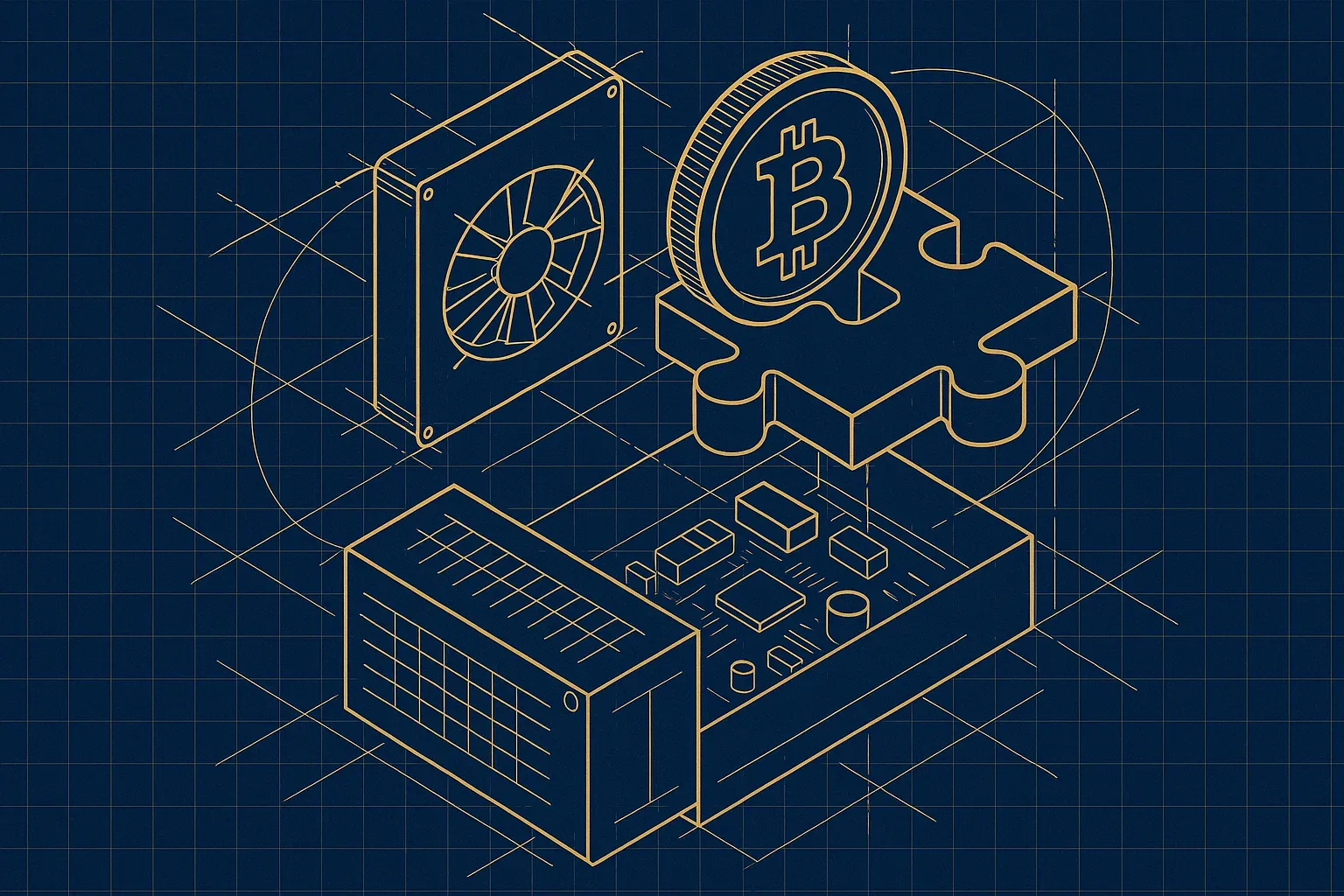
Introduction: Demystifying the Bitcoin Mining Puzzle
Bitcoin mining is often described as solving a complex cryptographic puzzle, a task that consumes immense computational power and is central to the network's operation. For many general readers, this concept remains shrouded in mystery, leading to misconceptions about what miners are actually doing. Far from being an arbitrary game, solving this puzzle is a fundamental requirement for validating transactions, securing the network against attacks, and generating new Bitcoin, thus maintaining the economic incentive for participation.
The Foundation: Understanding Cryptographic Hashing (SHA-256)
At the very heart of Bitcoin’s mining puzzle lies a cryptographic hash function known as SHA-256 (Secure Hash Algorithm 256-bit). A hash function is a mathematical algorithm that takes an input of any size and produces a fixed-size output, known as a hash or digest. For SHA-256, this output is always 256 bits, or 64 hexadecimal characters. What makes SHA-256 particularly suitable for Bitcoin is its suite of cryptographic properties: it is one-way, meaning it’s practically impossible to reverse-engineer the input from the output. It's deterministic, always producing the same output for the same input; it exhibits an avalanche effect, where even a tiny change in the input dramatically alters the output; and it's collision-resistant, making it computationally infeasible to find two different inputs that produce the same output. In Bitcoin mining, SHA-256 processes a block header, which contains various pieces of information like the hash of the previous block, transaction data, a timestamp, and crucially, a variable called the nonce. The cryptographic hash function creates the puzzle's difficulty by transforming this block header into a seemingly random, unique 256-bit string. The only way to find a hash that meets a specific criterion is through brute-force trial and error, as there's no shortcut to predict the output before computation.
The Core Challenge: What is the "Target Hash" and "Nonce"?
For a block to be considered valid and added to the blockchain, its hash must be less than or equal to this target hash. It's not about finding a specific hash, but rather finding any hash that falls within a very narrow range, determined by the target. The lower the target value, the more difficult it is to find a hash that is numerically smaller than it, as this requires the hash to start with more leading zeros. The nonce, short for "number once," is a 32-bit (originally, now often extended with extra nonce fields by mining pools) number that miners can change within the block header. Since SHA-256 is deterministic and sensitive to any input change, altering the nonce completely changes the output hash of the block header. The role of the nonce and target hash in solving the Bitcoin mining puzzle is fundamental: miners repeatedly adjust the nonce (and sometimes other data like the extra nonce in the coinbase transaction) to generate millions, even billions, of different block header hashes per second. Each time they change the nonce and re-hash the block header, they generate a new, unpredictable hash. This trial-and-error process is the essence of the "puzzle" itself.
The Mining Process: How ASICs "Guess" to Solve the Puzzle
The Bitcoin mining process is essentially a sophisticated guessing game, albeit one executed with extreme computational power. Miners first compile a new block of transactions, adding the hash of the previous block, a timestamp, and other metadata into what’s called the block header. The core of the puzzle-solving begins with the nonce. An ASIC miner starts with an arbitrary nonce value and then computes the SHA-256 hash of the entire block header. It then compares this computed hash to the network’s current target hash. If the computed hash is not less than or equal to the target, the miner simply increments the nonce by one and re-hashes the block header. This iterative process repeats millions, billions, or even trillions of times every second. There is no shortcut, no mathematical trick to derive the correct nonce; it is pure brute-force searching through an astronomical number of possibilities. How ASIC miners efficiently attempt to solve this computational challenge is by being purpose-built for this exact task. Unlike general-purpose CPUs or GPUs, ASICs are hardware designed with only one function in mind: executing SHA-256 hashing operations as quickly and energy-efficiently as possible. They strip away all unnecessary components, dedicating their entire architecture to parallelizing SHA-256 calculations. This allows them to perform an incredible number of guesses per second, measured in terahashes (TH/s) or even petahashes (PH/s), making them orders of magnitude more efficient than any other hardware for Bitcoin mining. This single-minded focus is their competitive advantage in the race to find the correct nonce and solve the block.
Proof of Work: Why Solving the Puzzle is Crucial
The act of solving the Bitcoin mining puzzle is fundamentally tied to a concept known as Proof of Work (PoW). The "puzzle" in Bitcoin mining is specifically designed to be computationally intensive but easy to verify. It requires miners to expend significant computational resources and energy to find a valid block hash (one that is less than or equal to the target). This expenditure of real-world resources proves that genuine effort, or "work," has been performed. This proof of work serves several vital purposes. Firstly, it prevents spam and denial-of-service attacks on the network. If creating new blocks were trivial, malicious actors could flood the network with invalid blocks or attempt to rewrite history without consequence. The high cost of computing PoW makes such attacks prohibitively expensive. Secondly, it secures the blockchain against double-spending. For an attacker to reverse a transaction or spend the same Bitcoin twice, they would need to regenerate the entire chain of blocks after their fraudulent transaction faster than the legitimate miners. This would require control over more than 50% of the network's total hashing power, known as a 51% attack, which is extraordinarily difficult and costly to achieve due to the collective hashing power dedicated to Bitcoin. By making block creation difficult, PoW ensures that once a block is added, it is incredibly expensive to alter, creating trust and immutability in a decentralized system without any central authority. Each solved puzzle extends the chain, securing all previous transactions.
Difficulty Adjustment: Ensuring Consistent Block Times
One of Bitcoin's most ingenious self-regulating features is its difficulty adjustment mechanism, which directly impacts the mining puzzle. The network aims to maintain an average block discovery time of approximately 10 minutes. To counteract these fluctuations and ensure a consistent block interval, Bitcoin automatically adjusts the mining difficulty every 2,016 blocks. This period translates to roughly two weeks, assuming the 10-minute target is met. During this adjustment period, the network measures the actual time it took for the previous 2,016 blocks to be found. If the blocks were found faster than two weeks (20,160 minutes), the difficulty is increased, meaning the target hash value is lowered, requiring miners to find a hash with more leading zeros and making the puzzle harder. If the blocks were found slower than two weeks, the difficulty is decreased, meaning the target hash value is raised, making the puzzle easier. This constant adjustment ensures that, regardless of how much total hashing power is active on the network, blocks are always found at a predictable rate. The impact on miners is immediate and significant; an increase in difficulty means they need more hashing power to maintain their share of block rewards, potentially reducing profitability, while a decrease can temporarily increase their chances of finding a block. For more in depth information on this critical process, you can explore resources like Bitcoin Mining Difficulty Explanation, Bitcoin Mining Difficulty: How the Network Self-Regulates, and How Bitcoin Difficulty Adjustment Works.
The ASIC Advantage: Speed and Efficiency in Puzzle Solving
The relentless demand for efficiency in solving the Bitcoin mining puzzle led to the advent of Application-Specific Integrated Circuits, or ASICs. In the early days of Bitcoin, miners used general-purpose CPUs (Central Processing Units) to compute SHA-256 hashes. As the network grew and difficulty increased, GPUs (Graphics Processing Units) took over, offering superior parallel processing capabilities. However, even GPUs were eventually outclassed by ASICs. The ASIC advantage lies in its singular, uncompromising focus. Every transistor, every circuit path within an ASIC is optimized for this specific cryptographic hashing operation. This specialization allows ASICs to achieve orders of magnitude higher hashrates (tens to hundreds of terahashes per second) while consuming significantly less power per hash compared to their general-purpose predecessors. They achieve this by eliminating all unnecessary components found in a CPU or GPU, such as memory controllers, display outputs, and versatile instruction sets. This narrow specialization makes them incredibly efficient at the brute-force guessing required to find a valid nonce and solve the Bitcoin puzzle, rendering other hardware types economically unviable for serious Bitcoin mining. This technological progression is a direct consequence of the escalating difficulty of the Bitcoin mining puzzle, driving innovation towards ever-more efficient computational power.
Beyond the Puzzle: Bitcoin's Security and Decentralization
Solving the cryptographic puzzle in Bitcoin mining has implications that extend far beyond simply earning block rewards. Each time a miner successfully finds a hash below the target, they prove that a significant amount of computational work has been expended. This Proof of Work is what makes the Bitcoin blockchain immutable; to alter any past transaction, an attacker would need to redo the work for that block and all subsequent blocks, which is computationally infeasible given the network's collective hashing power. This economic cost of producing valid blocks creates a robust defense mechanism against tampering and fraudulent activities, such as double-spending, fundamentally ensuring the network's integrity. This global distribution of mining power prevents any single entity from controlling the network, upholding Bitcoin's core principle of decentralization. The successful miner is rewarded with newly minted Bitcoin (the block reward, currently 3.125 BTC after the recent Bitcoin Fourth Halving Cuts Block Reward to 3.125 BTC) and transaction fees, providing a strong economic incentive to participate honestly and continue securing the network. This continuous expenditure of energy and competition to solve the puzzle reinforces Bitcoin's resilience, making it one of the most secure and robust financial systems ever created. The broader implications of the Bitcoin mining puzzle are a self-sustaining, trustless, and highly secure digital economy, underpinned by verifiable computational effort rather than centralized authority.